
Introduction
When weight reduction is a primary design goal, magnesium often deserves closer consideration than aluminum. Its lower density can deliver meaningful mass savings, while its high specific stiffness, strong vibration damping, and efficient die-casting behavior can improve both product performance and manufacturing outcomes. In many applications, these advantages translate into faster-moving components, better energy efficiency, reduced noise, and more complex parts made with fewer secondary operations. This article explains where magnesium outperforms aluminum, what trade-offs engineers must evaluate, and how the material choice affects strength, cost, processing, and end-use reliability.
Why Choose Magnesium Over Aluminum
The engineering mandate to reduce mass without compromising structural integrity has intensified the debate over lightweight metals. As industries push the boundaries of performance and efficiency, magnesium has emerged as a premier alternative to aluminum. Historically relegated to niche applications due to cost and processing challenges, advanced magnesium alloys and refined die-casting technologies have positioned the metal as a viable, high-volume production material. Understanding why to use magnesium instead of aluminum requires a rigorous evaluation of specific gravity, damping characteristics, and net-shape manufacturability.
At the core of this transition is the fundamental density advantage. Magnesium is approximately 33% lighter than aluminum and 75% lighter than steel. For engineering teams operating under strict weight budgets, this density reduction offers a direct pathway to improved kinetic efficiency and reduced payload penalties.
How does the choice affect product performance
Transitioning from aluminum to magnesium fundamentally alters the dynamic and static performance profiles of a component. The most immediate impact is the reduction in rotational and translational inertia. In dynamic assemblies, such as powertrain components or robotic end-effectors, this lower inertia translates to faster response times, reduced energy consumption, and diminished wear on actuating mechanisms.
Furthermore, magnesium exhibits exceptional specific damping capacity. The damping capacity of pure magnesium is highly favorable, and its commercial alloys often exhibit damping characteristics vastly superior to typical cast aluminum. This superior damping absorbs micro-vibrations and dissipates acoustic energy, making it an ideal choice for noise, vibration, and harshness (NVH) reduction in automotive cabin structures and precision optical housings. Finally, magnesium provides superior electromagnetic interference (EMI) and radio frequency interference (RFI) shielding compared to polymer alternatives, while outperforming aluminum in thin-wall structural rigidity.
Who should evaluate magnesium vs aluminum
The decision to evaluate magnesium over aluminum is highly relevant for engineering teams bound by stringent regulatory frameworks or extreme performance mandates. Automotive engineers tasked with meeting aggressive fuel economy standards or extending the range of battery electric vehicles (BEVs) are primary candidates for this material shift. In the BEV sector, every kilogram of mass removed can directly offset the heavy weight of battery packs, thereby extending operational range.
Aerospace designers optimizing payload-to-weight ratios, and consumer electronics hardware teams pushing the limits of device miniaturization, must also conduct this evaluation. In electronics, the demand for ultra-thin profiles requires materials capable of achieving wall thicknesses as low as 0.6 mm while maintaining torsional stiffness—a threshold where magnesium die-casting frequently outperforms aluminum. Procurement and lifecycle cost analysts should join these engineers in the evaluation process, as the initial raw material premium of magnesium is often offset by downstream manufacturing efficiencies.
Material Property Differences
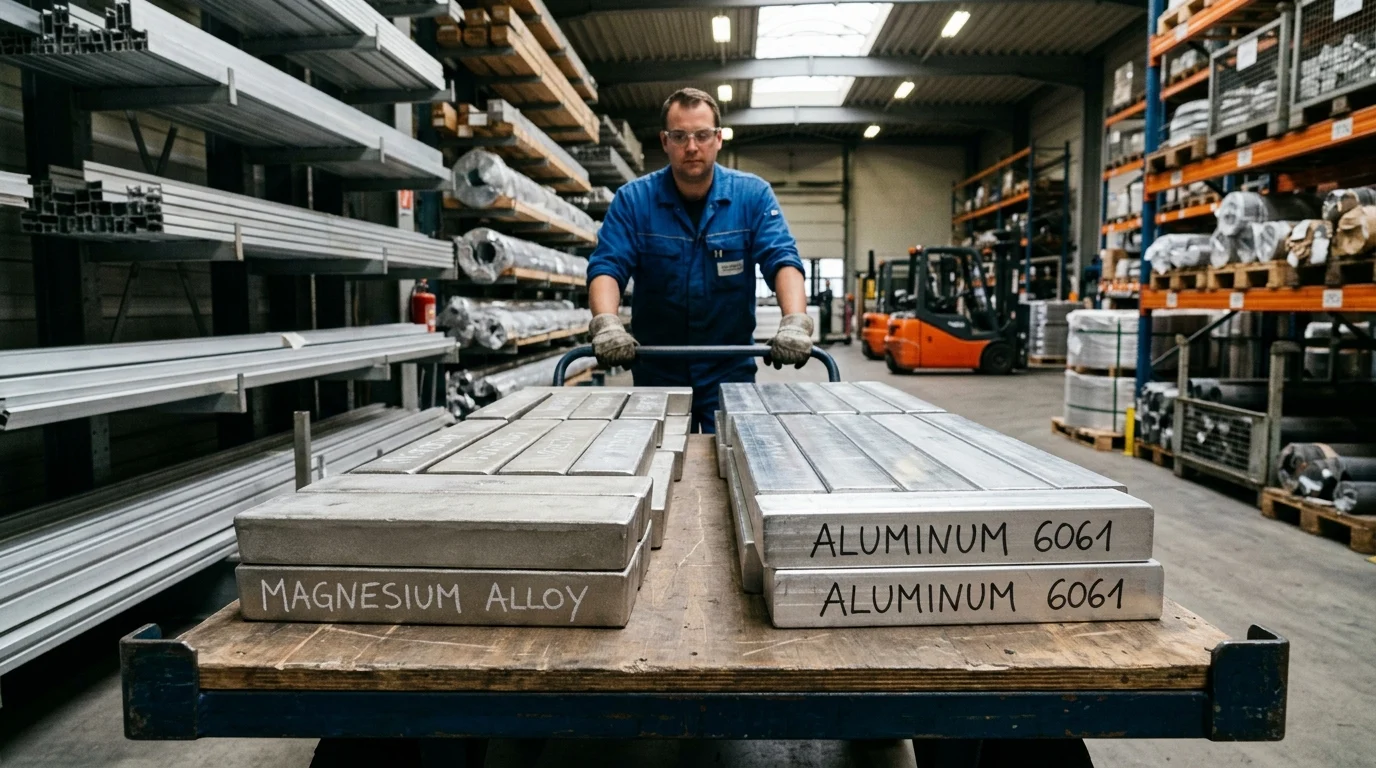
A rigorous material selection process relies on empirical data rather than generalized assumptions. While magnesium and aluminum share the “lightweight” classification, their mechanical, thermal, and chemical behaviors diverge significantly under operational stresses. Comparing standardized die-casting alloys—such as magnesium AZ91D and aluminum A380—reveals the specific trade-offs engineers must navigate.
How do weight, strength, stiffness, and thermal properties compare
The most prominent divergence lies in density: magnesium alloys typically measure 1.74 to 1.81 g/cm³, whereas aluminum alloys hover around 2.70 to 2.76 g/cm³. However, raw density must be contextualized by strength. While high-strength aluminum alloys generally possess higher absolute ultimate tensile strength (UTS) and yield strength, magnesium’s specific strength (strength-to-weight ratio) often matches or exceeds that of aluminum. This allows engineers to design magnesium parts with thicker cross-sections for added stiffness, while still achieving a lower overall mass than an aluminum counterpart.
Thermal properties represent a clear advantage for aluminum. Standard aluminum die-casting alloys offer thermal conductivity ranging from 100 to 130 W/m·K, whereas common magnesium alloys typically range between 50 and 75 W/m·K. Consequently, aluminum remains the superior choice for high-demand heat sinks and thermal management enclosures where rapid heat dissipation is the primary functional requirement.
How do corrosion, wear, creep, and galvanic risks compare
Environmental resilience is a critical vector in the magnesium versus aluminum debate. Historically, magnesium suffered from a reputation for poor corrosion resistance. However, modern high-purity (HP) alloys, which strictly limit heavy metal impurities like iron, nickel, and copper to parts-per-million levels, have drastically improved baseline corrosion resistance. Despite this, magnesium remains highly anodic. Galvanic corrosion is a severe risk when magnesium is placed in direct contact with dissimilar metals, such as steel fasteners or copper wiring, in the presence of an electrolyte. Mitigating this requires strict isolation strategies, such as isolating washers, specialized coatings, or aluminum intermediate layers.
Creep resistance—the tendency of a solid material to move slowly or deform permanently under the influence of persistent mechanical stresses—is another limiting factor for standard magnesium alloys at elevated temperatures. While aluminum maintains structural integrity well above 200°C, common magnesium alloys like AZ91D experience significant creep above 120°C. For high-temperature powertrain applications, specialized alkaline-earth magnesium alloys must be specified, which increases material costs.
What key comparison metrics matter most
To effectively compare these metals, engineers utilize quantitative metrics that map directly to part performance. The following table highlights the baseline mechanical and thermal properties of the most ubiquitous die-casting alloys for each metal: AZ91D (Magnesium) and A380 (Aluminum).
| Property / Metric | Magnesium AZ91D | Aluminum A380 | Advantage |
|---|---|---|---|
| Density (g/cm³) | 1.81 | 2.76 | Magnesium (Lighter) |
| Yield Strength (MPa) | 150 | 160 | Aluminum (Stronger) |
| Ultimate Tensile Strength (MPa) | 230 | 324 | Aluminum (Stronger) |
| Thermal Conductivity (W/m·K) | 72 | 109 | Aluminum (Better Dissipation) |
| Specific Damping Capacity | High | Low | Magnesium (Better NVH) |
These metrics demonstrate that unless absolute tensile strength or thermal conductivity are the overriding design constraints, the mass reduction offered by magnesium provides a compelling engineering advantage.
Manufacturing and Cost Considerations
The economic viability of transitioning to magnesium is rarely determined by raw material costs alone. Instead, the true financial impact emerges during the manufacturing phase. Differences in latent heat, machinability, and die wear can fundamentally alter the total cost of ownership (TCO) for high-volume production runs.
How do casting, machining, finishing, and joining differ
Magnesium possesses a significantly lower latent heat of fusion and lower volumetric heat capacity compared to aluminum. In die-casting operations, this means magnesium solidifies much faster within the die. Consequently, casting cycle times for magnesium can be 25% to 50% faster than those for identical aluminum components, drastically increasing machine throughput.
Machining magnesium is exceptionally efficient. It requires less cutting force, generates shorter chips, and extends tool life well beyond what is achievable with aluminum. Surface finishes achieved straight off the cutting tool are often superior. However, finishing and joining present distinct challenges. Magnesium typically requires specialized conversion coatings, such as titanate or zirconate treatments, prior to painting to ensure adhesion and corrosion protection. Joining magnesium also requires specialized welding techniques or structural adhesives, as traditional mechanical fasteners can induce galvanic corrosion or localized stress fractures.
How do sourcing, price volatility, and total cost compare
When evaluating raw commodity markets, magnesium ingot prices generally carry a premium over aluminum, historically fluctuating between 1.5x to 2x the cost of aluminum per kilogram. However, because magnesium is 33% lighter, the cost per unit volume—which dictates the actual material cost per cast part—narrows this gap significantly.
The most profound cost advantage for magnesium lies in tooling longevity. Because magnesium is cast at slightly lower temperatures and does not attack tool steel through iron soldering, die life is substantially extended. A typical H13 steel die casting an aluminum part might require replacement or major refurbishment after 100,000 to 150,000 shots. The same die casting magnesium can routinely exceed 250,000 to 300,000 shots. Over a high-volume production lifecycle, the savings in tooling capital expenditures frequently offset the higher initial raw material cost.
What safety, transport, recycling, and regulatory factors matter
Safety and regulatory compliance represent the most stringent barriers to magnesium adoption. Magnesium dust and fine chips generated during machining are highly combustible and pose a Class D fire hazard. Manufacturing facilities must implement strict housekeeping protocols, utilize specialized wet dust collectors, and employ mineral oil-based coolants rather than water-based emulsions, which can react with magnesium to produce explosive hydrogen gas.
From a lifecycle perspective, both metals are highly recyclable. However, remelting magnesium requires protective cover gases to prevent oxidation. Historically, foundries relied on sulfur hexafluoride (SF6), a potent greenhouse gas. Due to strict environmental regulations, modern facilities have transitioned to alternative cover gases like sulfur dioxide (SO2) or specialized fluxing agents. Navigating these safety and environmental transport regulations requires experienced supply chain partners capable of handling hazardous material classifications during the shipment of raw ingots or machining scrap.
Best Use Cases and Selection Criteria
Selecting between magnesium and aluminum requires balancing mass reduction goals against thermal, environmental, and cost constraints. While neither metal is universally superior, specific industry applications have established clear precedents for when to deploy each material to maximize product efficacy.
Which applications favor magnesium
Applications that demand strict weight minimization, high rigidity, and excellent vibration damping are ideal candidates for magnesium. In the automotive sector, magnesium is extensively specified for steering wheel armatures, instrument panel (IP) beams, and seat frames. Replacing a steel or aluminum seat frame with magnesium can yield weight savings of 1.0 to 2.0 kg per seating assembly, representing a massive reduction in the context of vehicle lightweighting.
In consumer electronics, magnesium is the material of choice for premium laptop chassis, camera bodies, and ruggedized tablet enclosures. The ability to die-cast magnesium into complex, thin-walled geometries, sometimes down to 0.55 mm, allows designers to achieve structural rigidity and drop-test survivability that plastics cannot match, without incurring the weight penalty of aluminum.
When is aluminum still the better choice
Aluminum remains the superior choice for components exposed to extreme operational environments. Applications requiring continuous exposure to temperatures exceeding 150°C to 200°C—such as engine blocks, cylinder heads, and turbocharger housings—rely on aluminum’s superior creep resistance and thermal stability. Furthermore, aluminum’s higher thermal conductivity dictates its use in high-performance heat sinks, LED lighting enclosures, and power inverter housings where rapid heat dissipation is critical.
Additionally, components deployed in highly corrosive environments, particularly marine applications with constant saltwater exposure, favor aluminum. Even with advanced coatings, the risk of coating degradation exposing a highly anodic magnesium substrate to a saltwater electrolyte presents too great a failure risk, making marine-grade aluminum alloys mandatory for these use cases.
How should teams validate material selection
Engineering teams must validate material selection through a structured decision matrix, quantifying trade-offs in mass, cost, and environmental durability. Finite Element Analysis (FEA) should be employed early in the design phase to verify if magnesium’s lower elastic modulus requires geometric thickening, which could negate expected weight savings.
| Design Priority | Recommended Material | Primary Technical Rationale |
|---|---|---|
| Maximum Mass Reduction | Magnesium | 33% lower density; superior specific strength. |
| Thermal Dissipation | Aluminum | >50% higher thermal conductivity (alloy dependent). |
| High-Temp Creep Resistance | Aluminum | Maintains structural stability above 150°C. |
| High-Volume Tooling Amortization | Magnesium | Die lifespan frequently exceeds 250,000 shots. |
| Severe Corrosive Environments | Aluminum | Superior baseline resistance; lower galvanic risk. |
Ultimately, the choice between magnesium and aluminum is a strategic engineering decision. By systematically analyzing the specific operational loads, thermal requirements, and lifecycle production volumes, teams can confidently specify the optimal lightweight alloy for their next-generation products.
Key Takeaways
- The most important conclusions and rationale for Why Use Magnesium Instead of Aluminum?
- Specs, compliance, and risk checks worth validating before you commit
- Practical next steps and caveats readers can apply immediately
Frequently Asked Questions
Why use magnesium instead of aluminum for die-cast parts?
Magnesium is about 33% lighter, offers better vibration damping, and supports thin-wall die casting. It is often chosen for automotive, electronics, and lightweight structural parts.
When is aluminum still the better material choice?
Aluminum is usually better for parts needing higher thermal conductivity, strong corrosion tolerance, or lower raw material cost, such as heat sinks and some outdoor housings.
Can magnesium parts match aluminum strength?
In many designs, yes. Magnesium often delivers competitive specific strength, so engineers can use optimized wall thickness and geometry to achieve low weight with adequate stiffness.
Which products benefit most from magnesium components?
BEV parts, robotic end-effectors, consumer electronics housings, and aerospace components benefit most because lower mass improves efficiency, handling, and payload performance.
Can JHPIM Supplier support magnesium manufacturing projects?
Yes. JHPIM Supplier can help evaluate lightweight metal options and manufacturability for production parts, especially when weight reduction and die-casting performance are priorities.