
Introduction
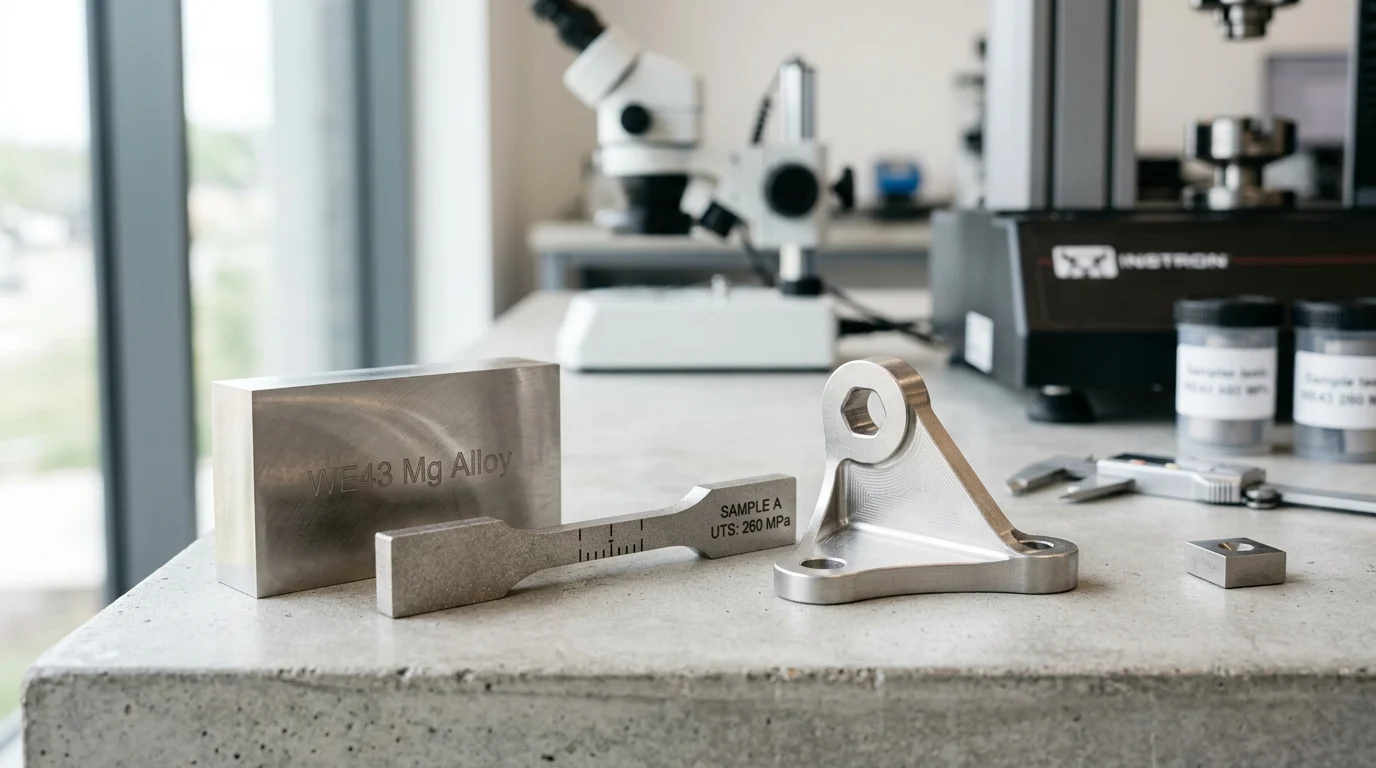
WE43 is a rare-earth magnesium alloy valued for combining very low density with unusually strong mechanical performance, especially at elevated temperatures. That balance makes it relevant in aerospace, defense, and motorsport parts where every gram matters but thermal and structural demands remain high. This article outlines the key properties of WE43, including strength, creep resistance, corrosion behavior, heat treatment response, and typical processing considerations. By the end, readers will have a practical understanding of where WE43 outperforms more common magnesium alloys and why it is selected for weight-critical, high-performance components.
Why WE43 Magnesium Alloy Matters
Engineered for demanding structural applications, WE43 is a specialized, high-strength magnesium alloy that relies on yttrium and rare earth elements to achieve exceptional mechanical stability. With a specific gravity of approximately 1.84 g/cm³, it remains one of the lightest structural metals available, offering a compelling alternative to traditional aluminum and titanium alloys in weight-critical sectors.
Unlike conventional magnesium alloys such as AZ91, which suffer from rapid mechanical degradation at elevated temperatures, WE43 retains its load-bearing capabilities in extreme thermal environments. This unique metallurgical profile establishes it as a premium material choice where mass reduction and high-temperature performance must be balanced simultaneously.
Applications in aerospace, defense, and motorsport
In the aerospace and defense sectors, WE43 is extensively utilized for rotary-wing aircraft components, particularly helicopter transmission casings, rotor heads, and auxiliary power unit (APU) housings. By replacing aluminum with WE43, aerospace engineers can achieve weight reductions of up to 25%, directly translating to increased payload capacity and extended operational range.
Motorsport engineering also relies heavily on this alloy. Formula 1 and high-performance endurance racing teams utilize WE43 for engine blocks, cylinder heads, and unsprung mass components like forged wheels. In defense applications, its high specific strength and thermal stability make it ideal for missile airframes and advanced tactical vehicle drivetrains, where materials must endure rapid thermal cycling without compromising structural integrity.
Performance benefits and trade-offs
The primary advantage of WE43 lies in its exceptional specific strength and its ability to operate continuously at temperatures up to 250°C (482°F), with short-term exposure capabilities reaching 300°C (572°F). This thermal resilience bridges the gap between standard lightweight alloys and heavier, heat-resistant metals.
However, these performance benefits come with notable trade-offs. The inclusion of rare earth elements makes WE43 significantly more expensive than standard magnesium or aluminum grades. Furthermore, like all magnesium alloys, WE43 is highly susceptible to galvanic corrosion when in contact with dissimilar metals in electrolytic environments. Mitigating this requires rigorous surface treatments, such as plasma electrolytic oxidation (PEO) or aerospace-grade epoxy primers, adding complexity and cost to the manufacturing lifecycle.
Composition and Mechanical Properties

The distinct capabilities of WE43 are a direct result of its highly controlled elemental composition. By moving away from traditional aluminum-zinc alloying systems, metallurgists have engineered a microstructure that resists the grain boundary sliding and phase degradation typically seen in magnesium at elevated temperatures.
Role of yttrium, rare earths, and zirconium
Yttrium (Y) is the primary alloying element in WE43, strictly maintained between 3.7% and 4.3% by weight. The addition of yttrium improves the alloy’s solid solution strengthening and enhances its corrosion resistance compared to older magnesium-thorium alloys. Rare earth elements, typically Neodymium (Nd) and Gadolinium (Gd), are added at concentrations of 2.4% to 3.2%. These elements form stable precipitates during heat treatment that pin grain boundaries and prevent dislocation movement.
Zirconium (Zr) is included at a minimum of 0.4% to act as a potent grain refiner. By nucleating fine grains during the solidification phase, zirconium ensures uniform mechanical properties across thick casting cross-sections, preventing the formation of coarse microstructures that could lead to premature fatigue failure.
Strength, creep resistance, and temperature performance
In the fully heat-treated T6 condition (solution heat-treated and artificially aged), WE43 exhibits an Ultimate Tensile Strength (UTS) ranging from 250 to 280 MPa, and a Yield Strength (YS) between 165 and 195 MPa. Its elongation at break typically hovers around 2% to 7%, depending on the specific casting method and section thickness.
A defining mechanical trait of WE43 is its outstanding creep resistance. While standard magnesium alloys experience significant creep at 120°C under loads of 50 MPa, WE43 can withstand continuous stresses of 100 MPa at 200°C for over 1,000 hours with minimal dimensional distortion. This makes it structurally viable for engine casings and gearbox housings that operate under continuous thermal and mechanical stress.
Property comparison overview
Comparing the mechanical profile of WE43 against standard magnesium and aerospace-grade aluminum alloys illustrates its unique market positioning.
| Material Grade | Density (g/cm³) | Yield Strength (MPa) | Ultimate Tensile Strength (MPa) | Max Operating Temp (°C) |
|---|---|---|---|---|
| WE43-T6 (Magnesium) | 1.84 | 165 – 195 | 250 – 280 | 250 – 300 |
| AZ91D (Magnesium) | 1.81 | 150 | 230 | 120 – 150 |
| A356-T6 (Aluminum) | 2.68 | 165 – 185 | 230 – 260 | 150 – 200 |
| Ti-6Al-4V (Titanium) | 4.43 | 880 – 950 | 950 – 1050 | 400 – 500 |
As demonstrated, WE43 offers yield and tensile strengths comparable to aerospace aluminum A356-T6 but at a 31% lower density, while drastically outperforming the thermal limits of the baseline magnesium AZ91D.
Processing and Quality Control
Manufacturing WE43 components requires stringent atmospheric controls and specialized thermal processing. The reactivity of molten magnesium combined with the oxidation sensitivity of yttrium demands advanced foundry practices to maintain metallurgical integrity.
Casting, extrusion, forging, and heat treatment
WE43 is highly amenable to sand casting, which is the preferred method for producing complex, large-scale geometries like helicopter transmissions. During pouring, shielding gases such as sulfur hexafluoride (SF6) or alternative fluorinated ketones must be used to prevent rapid oxidation. The alloy can also be extruded or forged, though these wrought processes require careful temperature control to avoid cracking.
To achieve maximum mechanical properties, WE43 undergoes a T6 heat treatment. This typically involves a solution treatment at approximately 525°C (977°F) for 8 hours in a protective atmosphere, followed by a rapid quench. The material is then artificially aged at 250°C (482°F) for 16 hours. This precise thermal cycle precipitates the fine rare-earth intermetallics necessary for high-temperature creep resistance.
Machining considerations
Magnesium alloys are celebrated for their machinability, and WE43 is no exception. It requires remarkably low cutting power—often 50% less than aluminum and 80% less than titanium. High-speed machining parameters can be aggressively applied, and engineers can routinely achieve surface finishes better than 1.0 µm Ra with standard carbide tooling.
However, the machining of WE43 introduces significant fire hazards. Fine magnesium chips and dust are highly combustible. Machining operations must employ high-volume mineral oil-based coolants (water-based coolants are strictly prohibited due to hydrogen gas generation risks) and specialized dust extraction systems to mitigate the risk of ignition.
Inspection, certification, and lot consistency
Quality assurance for flight-critical WE43 components demands rigorous non-destructive testing (NDT). Castings are typically certified to AMS 4427 or similar aerospace standards, requiring 100% digital radiography (X-ray) inspection to ensure porosity and inclusion levels meet Class 1 or Class 2 requirements per ASTM E155.
Lot consistency is heavily dependent on the foundry’s ability to prevent rare-earth segregation during cooling. Chemical composition is verified via optical emission spectroscopy (OES) for every melt, and test bars are cast alongside production parts to validate that the T6 heat treatment achieved the specified minimum yield and tensile thresholds.
Supply Chain, Cost, and Compliance
The commercial viability of WE43 is heavily influenced by the dynamics of the global rare earth elements market and the strict regulatory frameworks governing the handling of combustible metals. Sourcing this alloy involves navigating a specialized supply chain distinct from standard commodity metals.
Raw material availability and pricing
The raw material cost for WE43 is substantially higher than baseline magnesium. While standard AZ91 ingots might trade between $3 to $6 per kilogram, WE43 ingots typically range from $30 to $50 per kilogram, subject to the volatility of yttrium and neodymium prices. This 5x to 10x cost multiplier restricts the alloy to applications where weight savings have a quantifiable, high-value return on investment.
Availability is generally constrained to a few specialized global producers capable of mastering the complex alloying process. For custom extruded profiles or specific forged billets, Minimum Order Quantities (MOQs) can range from 500 to 1,000 kilograms. Lead times for aerospace-grade certified WE43 castings frequently extend from 16 to 24 weeks, necessitating strategic supply chain forecasting.
Standards, traceability, and handling requirements
Due to its application in defense and advanced aerospace, technical data and certain WE43 component designs may be subject to International Traffic in Arms Regulations (ITAR) or Export Administration Regulations (EAR) in the United States, requiring strict traceability and access controls.
From a facility standpoint, handling WE43 requires strict compliance with standards such as NFPA 484 (Standard for Combustible Metals). Facilities must be equipped with Class D fire extinguishers, specialized chip storage containers, and explosion-proof vacuum systems. Scrap segregation is also critical; WE43 chips must be meticulously separated from aluminum and standard magnesium scrap to maintain recycling value and prevent dangerous chemical reactions.
Selection and Specification Guidance
Specifying WE43 requires a holistic engineering evaluation to justify its cost premium and processing complexities. Material selection must move beyond simple tensile strength comparisons to include lifecycle thermal exposure, galvanic integration, and mass-value economics.
Engineering evaluation process
The engineering evaluation process begins with a rigorous finite element analysis (FEA) to determine if a lighter magnesium structure can handle the required load paths without excessive deflection. Because the modulus of elasticity for WE43 is approximately 44 GPa (compared to 69 GPa for aluminum), sections may need to be thickened to maintain stiffness, which can offset some of the theoretical weight savings.
Engineers must calculate the “cost per kilogram saved.” In commercial automotive applications, paying $50 to save a kilogram of mass is rarely viable. However, in low-earth orbit space launches or commercial aviation, where saving a single kilogram can yield $1,000 to $10,000 in lifecycle fuel or payload value, the premium for WE43 is easily justified.
When WE43 is the right material choice
WE43 is the optimal material choice when component weight directly dictates operational feasibility, and the operating environment consistently exceeds 150°C, rendering standard magnesium useless and aluminum marginally effective.
| Selection Criteria | WE43 (Magnesium) | Ti-6Al-4V (Titanium) | 7075-T6 (Aluminum) |
|---|---|---|---|
| Specific Strength (kN·m/kg) | ~140 | ~200 | ~204 |
| Machinability Index | Excellent (100) | Poor (20) | Good (80) |
| Relative Raw Material Cost | High (5x – 8x) | Very High (10x+) | Baseline (1x) |
| Modulus of Elasticity (GPa) | 44 | 114 | 71.7 |
Ultimately, WE43 should be specified when the design requires the machinability and extreme light weight of magnesium, combined with the thermal resilience typically reserved for heavier alloys. When paired with appropriate galvanic isolation coatings, it remains a premier structural solution for next-generation aerospace and high-performance engineering.
Key Takeaways
- The most important conclusions and rationale for WE43 Magnesium Alloy Properties
- Specs, compliance, and risk checks worth validating before you commit
- Practical next steps and caveats readers can apply immediately
Frequently Asked Questions
What makes WE43 magnesium alloy different from standard magnesium grades?
WE43 uses yttrium, rare earths, and zirconium for higher strength and much better high-temperature stability than common grades like AZ91.
How hot can WE43 operate in service?
WE43 can typically run continuously up to about 250°C, with short-term exposure reaching around 300°C when properly designed and heat treated.
Where is WE43 magnesium alloy commonly used?
It is used in aerospace housings, helicopter parts, defense components, and motorsport engine or lightweight structural parts where weight and heat resistance matter.
What are the key mechanical properties of WE43-T6?
Typical WE43-T6 values are 250–280 MPa ultimate tensile strength, 165–195 MPa yield strength, and density near 1.84 g/cm³.
What should manufacturers watch for when using WE43?
Control galvanic corrosion with proper coatings or isolation, and account for higher material cost due to rare earth content and added surface-treatment needs.